


Betting Big On Change: The Philippines Look To A Renewed Line-Up For A More Formidable Future
More than just an Asia Cup story – with the FIBA 3×3 World Cup Qualifier deciding their fate at the same venue next week, the Philippines have placed their hopes in a reworked women’s team, with a higher ceiling in mind and two consecutive chances to find out quickly whether this new version can take them further than the last
By Wong Chin Yi
For the Philippines, this year’s FIBA 3×3 Asia Cup is not simply another attempt to build on last season’s fourth-place finish. After all, this two-week stretch in Singapore will be a tough test of whether a team can move away from a trusted core without losing the qualities that made it so difficult to play against in the first place, against elite competition. Drawn in Pool D against repeat champions Australia for the Asia Cup and in Pool B against powerhouses Brazil and hosts Singapore for the World Cup Qualifiers, the Philippine women will have their work cut out for them just to advance to the knockout stages.
This tough stretch is what makes their final roster particularly intriguing. They have brought over a squad with obvious talent, but also with a different look and, in some respects, a different logic.
For years, the Philippines had something rare in 3×3: a combination that felt settled and intuitive. Mikka Cacho, Jhazmin Joson, Camille Clarin and Kaye Pingol had grown into a group whose chemistry was unmistakable. Their skill sets meshed cleanly, their teamwork had a natural rhythm, and the balance between them was one of the team’s clearest strengths. Cacho remains, but the rest of that long-standing core has given way to a new mix: Afril Bernardino, Kacey Dela Rosa and Cheska Apag now join her in Singapore.
This change is certainly not a cosmetic one, and will alter the feel of a team that fans at the OCBC Square may have already grown familiar with. Clarin, for instance, brought a particular kind of structure to the Philippines’ game. From the high post, she could facilitate, connect actions and keep possessions flowing, often making the right pass before the defense fully settled. Dela Rosa is a very different kind of player. She is much more forceful inside, more naturally imposing as a scorer and defender around the basket, and more likely to shape a game through direct physical impact than orchestration. Although both players are undeniably valuable, they will require the team to fit together in different ways.
The same is true elsewhere on the roster. Bernardino is one of the most accomplished and instinctively gifted players in Philippine women’s basketball – a genuine bucket-getter with the craft, footwork and touch to create something for her side when little seems available. She also has the explosiveness and athleticism to compensate for her size, and routinely dominates the boards against much bigger players. But she is not a like-for-like substitute for what Pingol and Joson brought to that older unit. Pingol’s incredible defensive hustle and off-ball activity gave the team constant motion and edge, while Joson’s self-assured three-point shooting stretched the floor and sharpened the spacing around everyone else.
Replacing those qualities is not simply a matter of changing names on a team sheet – it means recalibrating how the side functions, and how it aims to excel.
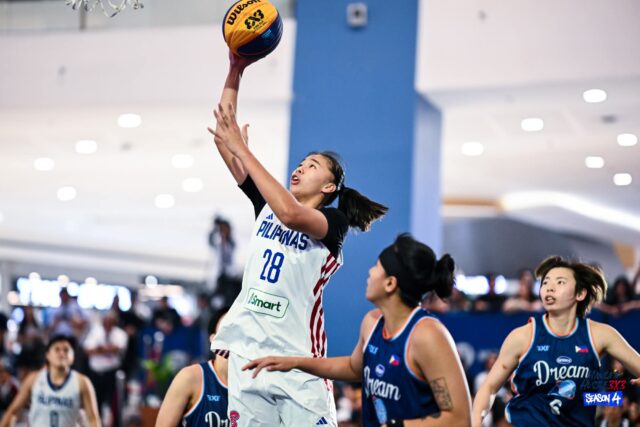
That is why this tournament feels, in a very real sense, like a gamble. Not a reckless gamble, because the talent coming in is real, but a genuine leap all the same. Bernardino is one of the biggest names in Philippine basketball. Dela Rosa gives the team an inside presence few sides in the region can match when she plays with authority, and her potential in 3×3 is obvious. Apag brings another reliable option, while Cacho provides a dynamic, relentless driving threat as well as a link between this group and the one that came so close to a podium finish last year.
The real question is whether that individual quality can turn into cohesion quickly enough. In 3×3, there is no time for a team to grow into a tournament slowly – lose a game or two, and you will find yourself on a plane ride back home real soon. The game moves too quickly, the margins are too thin and the format is too unforgiving for a team to spend much time searching for itself. A team either plays connected or it does not.
And that gets to the deeper issue. The Philippines were so effective last year not only because they had talent, but because the pieces fit naturally. Everyone’s role complemented the others. This version of the team may prove stronger, more flexible and harder to handle in certain matchups. But strength is not the same as chemistry, and that is the true challenge in Singapore.
That is the challenge in Singapore. The Philippines have to show that this group can become more than just an impressive collection of names. There is reason to think it can. Cacho is a live-wire creator and slasher who gives the side continuity. Bernardino brings experience and one-on-one shot-making. Dela Rosa adds something the team did not quite have in the same way before: a genuine interior force who can control possessions on both ends of the floor. If those pieces click quickly, the Philippines may not just manage this transition, but come through it with an even higher ceiling than before.
With a difficult draw and little room for a slow start, the schedules and match-ups in these two weeks will be asking a lot of the Philippines. How well they step up to answer the call will shape not only how far they go in these two tournaments, but also what this programme will look like, moving forward.
